
Navigating the infrastructure gap: How utility capacity and entitlement complexity are redefining land value in the Triangle.
The Triangle land market is sending mixed signals, and landowners are paying the price for misreading them.
Demand for developable land in the Raleigh-Durham metro has remained strong into 2026, with out-of-state developers continuing to enter the market and established local players actively hunting for sites. And yet properties are sitting longer with fewer offers, and contracts are getting renegotiated or walked away from entirely. The bid-ask gap between sellers and buyers has become more visible.
This isn’t just a pricing story. It’s a process story – and most landowners don’t know it yet.
The Value Is There. The Path to It Is Not.
For landowners in a growth market like the Triangle, the instinct is understandable: you have land, developers want land, so sell. The problem is when and how that transaction happens. Most landowners exit too early, accepting a discounted offer on raw or under-entitled land, therefore handing the upside – often substantial – to the buyer.
Consider what happens on the other side of that transaction. A developer acquires land at a compressed price to offset entitlement risk and carrying costs, then navigates a two-to-three-year process to make it shovel-ready. The capital markets only engage on a project once a site reaches that threshold. Once entitlements are in place, the land is worth materially more. The person who owned it a year earlier only saw part of that value.
That gap is not inevitable. It is often a knowledge problem – one created by the lack of guidance most landowners never even knew they needed.
The Entitlement Gap Is Real — and Costly
Land entitlements remain one of the most misunderstood risk factors in real estate development today. The process can take two to three years and cost hundreds of thousands of dollars, with no guarantee of success. That is the risk developers price into every offer they make on raw land. They aren’t being unreasonable. They’re being rational. The question is whether landowners can capture some of that upside themselves, rather than transfer it.
In the Triangle specifically, the entitlement environment has added new complexity. Utility capacity constraints are actively shaping where, and whether, development can proceed. Holly Springs is mid-expansion on a $500 million wastewater infrastructure investment that won’t reach full capacity until 2029. Fuquay-Varina faces a hard water supply ceiling by 2030 with no state resolution yet in sight. Franklin County needs water capacity now. Durham County has sewer bottlenecks stopping new construction. Apex has moved toward a moratorium on utility-intensive data centers. For a landowner sitting on raw land in or near these corridors, the difference between moving now versus waiting – and between selling raw versus entitled – can often be measured in millions of dollars.
That wait-and-see posture has a cost. Markets don’t pause while landowners deliberate. Capital alignment, competitive sale processes, and buyer relationships take time to build – and the landowners who understand that – are the ones who maximize value.
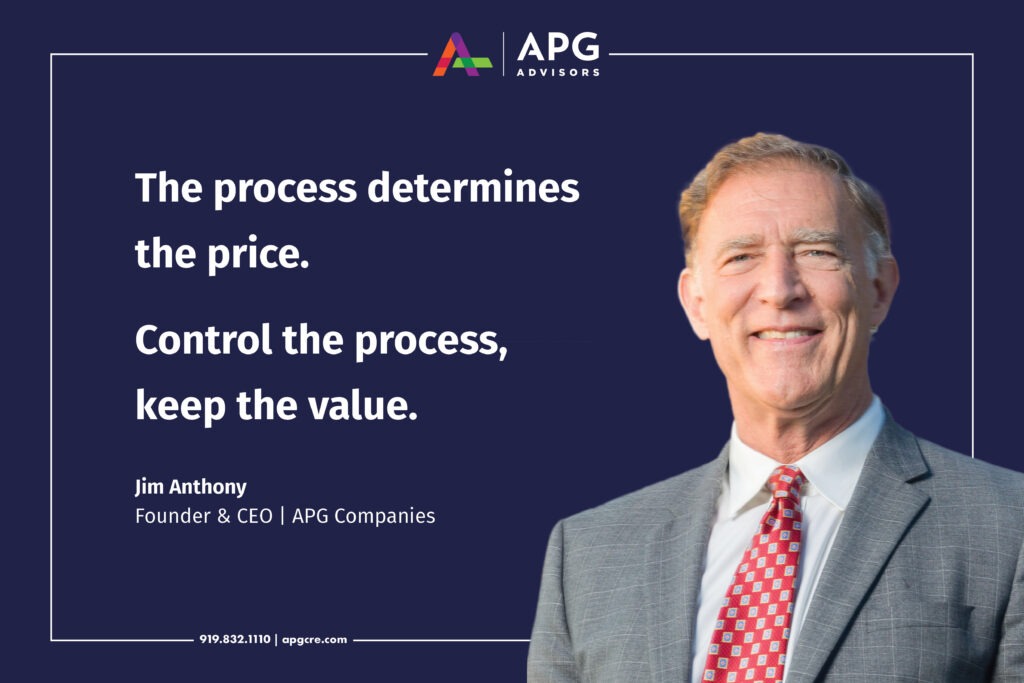
The Process Is the Product
What separates landowners who capture full value from those who don’t is rarely the land itself. It’s whether they have a structured process – one that sequences planning, feasibility, entitlement, capital alignment, and sale in the right order, at the right time, with the right buyers already engaged.
The real estate industry has evolved into a series of disjointed functions, each delivering services according to their own priorities. Landowners typically lack a single resource to help them assess feasibility, navigate entitlement, or optimize a property’s value — and those misaligned incentives between service providers and landowners can result in significant misspent capital.
A structured advisory approach with the right team changes that equation. Rather than selling into the first reasonable offer, landowners who engage a disciplined process can control the factors that determine their land’s value – then execute a competitive sale that reflects it.
What This Means for Triangle Landowners Right Now
The Triangle remains one of the most active land markets in the Southeast. Population growth, infrastructure investment, and continued in-migration of institutional capital all support long-term demand. But market strength alone doesn’t protect a landowner who exits at the wrong stage of the value cycle.
For owners sitting on raw, under-entitled, or transitionally zoned land in this market, the question is not whether there is value to capture. It’s whether you have the process – and the team – to actually capture it.
Jim Anthony is founder and CEO of APG Companies, a Raleigh-based vertically integrated commercial real estate firm. APG Land Development Services guides landowners through planning, entitlement, capital alignment, and competitive sale processes to maximize land value. Learn more about APG at www.apgcre.com