

Fewer Deals, Higher Prices: Five years of data show North Carolina’s commercial land market has grown quieter and more expensive at the same time. The median price per acre is up 52% since 2021 even as annual deal volume fell by more than half.
Five years ago, a good piece of commercial land often sold on potential. Today, buyers are paying for certainty and paying more to get it.
That’s the clearest conclusion from an analysis of more than 5,700 commercial land transactions across North Carolina between July 2021 and July 2026. Median price per acre climbed roughly 52% over that period without a single down year. Over the same stretch, the number of closed deals fell by more than half from its 2022 peak.
Rising prices and falling deal count sound like they should contradict each other. They don’t. They describe a market where fewer sites are trading, and the ones that do are getting bid up by buyers who need exactly that site – not a comparable one down the road.
The Number That Matters
Median, not average, is the number to trust here. A handful of outlier transactions (data centers, life sciences campuses, pharmaceutical manufacturing sites) pay five to ten times the typical price per acre and can swing an average wildly from year to year. The median holds steady as the more reliable read on where the broad market actually sits, and on that measure, the trend line has only gone one direction since 2021: up.
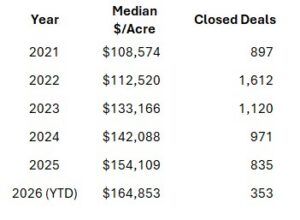
Deal count tells the other half of the story. Transaction volume peaked at 1,612 closed deals in 2022 and has fallen in every year since, down to 835 in 2025. Fewer buyers are transacting, but the ones who are transacting are paying more for what’s available — the signature of a market where supply, not demand, is the binding constraint.
Disclosed transactions over the five years total more than $11.4 billion. And roughly 70% of buyers, by deal count, are headquartered outside North Carolina — under 30% are local. Whatever is setting the price floor in this state right now, it isn’t primarily local capital.
Who’s Paying the Outlier Prices
The gap between median and average pricing is explained almost entirely by a specific class of buyer. Data center, life sciences, and pharmaceutical manufacturing deals are landing at price points the broader market never approaches:
• Digital Realty paid $160 million for 155 acres in Charlotte in late 2024 — then returned in early 2025 for an adjacent parcel (a $20 million acquisition at 13101 Moores Chapel Road), building toward a 400-megawatt data center campus and folding the site into a $3.25 billion U.S. hyperscale data center fund that closed in March 2026, with Charlotte named as one of the fund’s key Tier I markets.
• Eli Lilly paid roughly $50 million for a 415-acre site in Concord in 2022 — the former Philip Morris tobacco manufacturing property, now anchoring a $2 billion-plus pharmaceutical plant spanning more than 1 million square feet. Tobacco land converting to pharma manufacturing land is as clean a symbol of North Carolina’s economic transition as the data offers.
• AbbVie closed on roughly 171-185 acres across 18 parcels in Durham County for $49 million in 2026, anchoring a $1.4 billion drug manufacturing campus. In Apex, the joint UNC Health/Duke Health venture behind NC Children’s — the state’s first standalone children’s hospital — paid RXR nearly $90 million for 200-plus acres within the Veridea development, part of a project expected to top $2 billion at completion.
• Compass Datacenters – per county deed records, the Stamey family’s roughly 335-acre farm on Stamey Farm Road in Statesville closed for approximately $41 million in early 2026, following a unanimously approved rezoning in September 2025. Compass has publicly proposed a 1.34 million-square-foot, five-building data center campus for the site, adjacent to Duke Energy substation infrastructure — extending the data center footprint well outside the traditional metro cores.
Not every big land bet from the 2021–22 boom has aged well, illustrating a distinct risk premium between speculative commercial projects and heavy manufacturing infrastructure. In August 2021, at the peak of the biotech capital cycle, Alexandria Real Estate Equities bought a 95-acre Research Triangle Park site for $91.5 million; in January 2026, as part of a broader corporate pivot to rebalance its national portfolio, it sold the site to King Street Properties for $29.5 million. The transaction reflects a sharp cyclical correction, against a backdrop of life-sciences lab vacancy above 32% in Raleigh-Durham, rather than a retreat from the region, where Alexandria remains a dominant landlord.
One State, Four Different Markets
North Carolina has never traded as a single land market, and the last five years make that more true, not less.
Charlotte is the state’s most active market by deal count. but the price trend has real texture to it. Median price per acre climbed steadily from $128,000 in 2021 to a peak of $230,000 in 2024, then eased to $224,000 in 2025 and $164,000 through mid-2026 – the clearest cooling of any major metro in this data, even as the marquee deals keep landing here. The outlier worth knowing: Duke Energy paid $40 million, or $8.66 million per acre, for a 4.6-acre uptown parcel on West Morehead Street. Urban infill and suburban tracts are pricing in two different universes inside the same county line.
The Triangle (Raleigh-Durham) This is the cleanest uptrend in the state. Raleigh’s median climbed from $169,000 to $252,000 per acre with no down year at all – an uninterrupted 49% increase. Durham moved even further, from $88,000 to $226,000, accelerating sharply in the past two years on the strength of life sciences and pharma manufacturing demand. However, this growth is tempered by the Alexandria/King Street resale noted above, a reminder that Triangle land pricing now carries real asset-level risk alongside its upside.
The Triad is the region where the statewide story breaks down. Greensboro’s median dipped through 2022-2024 before jumping in 2025-26; Winston-Salem shows no consistent direction across the full five years, spiking only in the most recent partial-year data. This is a market still finding its footing, not one riding the same scarcity dynamic as Charlotte or the Triangle – worth watching for whether the recent uptick holds.
Wilmington posts the highest median price per acre of any county with meaningful volume, but the number needs a caveat before it gets repeated as “priciest land in the state.” New Hanover’s typical parcel runs smaller, about 3.4 acres versus 5 to 7 acres in the major metro counties, and small urban infill lots simply price higher per acre than large suburban tracts. It’s a real signal about tight coastal supply. It isn’t an apples-to-apples comparison with Charlotte or Raleigh’s larger development sites.
What the Data Suggests
Commercial land has never been valued by the acre alone — it’s valued by what can be built on it, how fast, and how certainly. That’s always been true. What’s changed is how much buyers are now willing to pay for the “how certainly” part.
The market is rewarding infrastructure readiness, entitlement feasibility, and municipal cooperation over raw location or acreage. Sites that can move cleanly from acquisition to development are drawing real competition; sites that require years of uncertainty are taking longer to trade, if they trade at all.
That doesn’t mean every landowner should expect institutional pricing. Most land in this state still trades on the fundamentals it always has: zoning, access, physical constraints, and local demand. But for brokers, developers, and investors working the top of this market, the conversation has moved past acreage and price per acre. It’s now about whether a site can credibly deliver what a buyer needs, on their timeline.
For landowners, that reframes the question. It’s no longer just “What is my land worth?” It’s “How valuable is my land to the buyer who needs exactly what it offers?” Those two answers are increasingly not the same number.
By APG Companies Research
Analysis based on more than 5,700 closed North Carolina commercial land transactions, July 2021 through July 2026. Agricultural-zoned and platted residential lot-level parcels were excluded; figures reflect disclosed sale prices only.
The commercial land market continues to evolve, but one principle remains constant: informed decisions create better outcomes. At APG Companies, our land specialists work with owners, developers, investors, and institutions throughout North Carolina, providing the market insight and transaction expertise needed to navigate today’s increasingly competitive landscape. Meet APG’s Commercial Land Advisors and learn how we help clients unlock the full potential of commercial land.